Sunday, December 19, 2010

Yes, Virginia, There is a Santa Claus

Have a Safe & Happy Holiday Season!
Laura Virginia O'Hanlon
From "The New York Sun"
  Tuesday September 21 1897

    Is There a Santa Claus?
We take pleasure in answering at once 
And thus prominently the communication 
below, expressing at the same time our 
great gratification that its faithful author 
is numbered among the friends of THE SUN:

 -Dear Editor I am 8 years old.
   Some of my little friends say there is no Santa Claus

 " Papa said 'if you see it In THE SUN, It's so.'
 " Please tell me the truth; Is there a Santa Claus?
                         •Virginia O'Hanlon

 115 West Ninety-Fifth Street   -

 VIRGINIA, your little friends are wrong. They have been affected by the skepticism of a skeptical age. They do not believe except they see. They think that nothing can be which is not comprehensible by their little minds. All minds, VIRGINIA, whether they be men's or children's, are little. In this great universe of ours Man is a mere insect, an ant in his intellect as compared with the boundless world about him, as measured by the intelligence capable of grasping the whole of truth and knowledge.

   Yes, VIRGINIA, there is a Santa Claus. He exists as certainly as love and generosity and devotion exist, and you know that they abound and give to your life its highest beauty and joy. Alas! how dreary would be the world if there were no Santa Claus. It would be as dreary as if there were no VIRGINIAS. There would be no childlike faith then, no poetry, no romance to make tolerable this existence. We should have no enjoyment except in sense and sight. The eternal light with which childhood fills the world would be extinguished.

   Not believe In Santa Claus! You might as well not believe in fairies! You might get your papa to hire men to watch in all the chimneys on Christmas Eve to catch Santa Claus, but even if they did not see Santa Claus coming down, what would that prove? Nobody sees Santa Claus, but that is no sign that there is no Santa Claus. The most real things in the world are those that neither children nor men can see. Did you ever see fairies dancing on the lawn? Of course not, but that's no proof that they are not there. Nobody can conceive or imagine all the wonders there are unseen and unseeable in the world.

   You may tear apart the baby's rattle and see what makes the noise inside, but there is a veil covering the unseen world which not the strongest man, nor even the united strength of all the strongest men that ever lived, could tear apart. Only faith, fancy, poetry, love, romance, can push aside that curtain and view and picture the supernal beauty and glory beyond. Is it all real?  Ah, VIRGINIA, in all this world there is nothing else real and abiding. No Santa Claus! Thank God! he lives, and he lives forever! A thousand years from now, VIRGINIA, nay, ten times ten thousand years from now, he will continue to make glad the heart of childhood.
Francis Church

  What became of  Virginia O'Hanlon?

    Her letter and the response became famous, though this was not the extent of her life’s work. She earned a master’s degree from Columbia University as well as a PhD from Fordham University in New York City, and became a teacher and principal who worked for 43 years before retiring in 1959.
    A New York Times article published June 12, 1959, reports on a retirement dinner given to her — then with her married name, Laura Virginia O’Hanlon Douglas — at which a teacher named Mary Kasansky, who worked at the school where O’Hanlon Douglas was “junior principal,” read the editorial to the 30 guests.
    It noted that the school that she helped run consisted of “classes held in 10 hospitals and other institutions for chronically ill children” and that her “devotion and sensitivity to the needs of her pupils” were highly praised by administrators.
    She died May 13, 1971, at 81. Her New York City childhood home in Greenwich Village became the first home of the Studio School, which now has a scholarship in her name. The Web site says:
"In the tradition of a curious young girl, Virginia, who lived in the house that became our school, we celebrate the promise and fulfillment of every child. The Virginia O’Hanlon Scholarship Fund will make it possible for more children to grow up to believe in themselves, and embrace the journey of learning. Virginia grew up to be an educator and advocate for children’s rights and believed that all children, regardless of social background, should have the same learning opportunities."


Who was Francis Church?

   Born on February 22, 1839, in Rochester, New York, newspaper editor and writer Francis Pharcellus Church wrote one of the most famous newspaper editorials of all time. He penned a response to a young girl's query about the existence of Santa Claus in 1897 that remains popular to this day.
   Francis P. Church was the son of a reverend and the grandson of a Revolutionary War soldier. He graduated from Columbia College (Columbia University) in 1859. For a time, Church considered a career in law, but soon abandoned that idea for a life in media.   
   During the Civil War, Church worked as a war correspondent. He also worked with his brother, William Conant Church, on The Army and Navy Journal. The pair also established a literary publication called Galaxy Magazine in 1869. Contributors to Galaxy included Mark Twain and Henry James.
   By 1897, Francis P. Church was working for the New York Sun. That year he was asked to reply to a letter from an 8-year-old girl named Virginia O'Hanlon asking about Santa Claus. While he wrote many articles and editorials during his lifetime, Church will always be remembered best for his moving commentary on Santa Claus. He died on April 11, 1906, in his New York City home. For a few years, no one really new who wrote the editorial. Because of The Sun's policy of editorial anonymity, it wasn't revealed until after his death. 
   Over the years, Church's defense of Santa Claus has been reprinted numerous times in magazines and newspapers. It has also inspired several books, including the 2001 children's illustrated tale Yes, Virginia, There Is a Santa Claus. The story of O'Hanlon's letter and Church's reply have formed the narrative for a number of films, most recently the 2009 television special, Yes, Virginia.


ALSO SEE: A CHRISTMAS MIRACLE, BY BUFFALO'S TAYLOR CALDWELL

Thursday, December 9, 2010

Kenmore's Driving Force For The Physically Challenged

Genius of P.A. Dunn Boon to Handicapped
Courier Express February 21, 1965
                     By H. K. Smith

Mr. Dunn Holds His Single and Double
Shifts for Handicapped Drivers
  INVENTOR OF NOTE -- The varied inventions of Paul A. Dunn Jr. range from a jack for airplanes that is used on a Gemini spacecraft, to special equipment for the handicapped and for hospital patients. The Dunn Manual Drive Control enables a handicapped driver to operate the brakes and accelerator of his car with either his right or left hand. That is the invention for which Paul Dunn is internationally known. Recently he received enquiries concerning it from Ford Motor Co. of Buenos Aires, Argentina.
   HAVE A GOOD RECORD -- The portable control, costing less than $100, has made driving possible for thousands of handicapped men and women. Mr. Dunn has instructed several hundred in its use and reported the safety records 300 users are above average. Jefferson High School of Rochester has added this control to it's driver education equipment and currently is instructing 20 handicapped teenage students. "If normal drivers would use my manual control, accidents could be reduced," Mr. Dunn maintains. "By eliminating that fraction of a second required to move the foot from accelerator to brake, my control shortens by 22 ft. the space a car travels after the driver moves to stop it." 

Patent Drawing For Driving Controls
  REGULATES SPEED -- Also the Dunn Control can set the car's speed, (cruise control) thereby relieving the driver from keeping the foot on the accelerator. "This lessons driver fatigue, a recognized cause of accidents," Mr. Dunn said. For the Chronic Disease Research Institute and Meyer Memorial Hospital, Mr. Dunn has designed and invented equipment for the alleviation of pain and rehabilitation of the handicapped.  A patent is pending for his body support for relief and prevention of decubitus lesions and burns (bed sores). The basic pad is a circular pad covered with a washable material.
  PROVIDE SUPPORT -- An arm or leg can be thrust through a hole in the center to place the cushion where it is most needed.  Within the central aperture are tiny pyramids of material, firm enough to give support to the limb, yet pliable for comfort. This pad, and equipment to hold bent toes in position to make walking possible, were originated by Mr. Dunn during three years at Meyer Memorial Hospital. He was supervisor of planning and equipment for the pre-vocational evaluation center for the hospital. He deems his Dunnometer more than just an exerciser and tester for virtually any muscle in the body. "It's a gauge, that the patient can watch, has psychological value," he said. "It enables the patient, recovering from a stroke, to check the improvement of his muscles every day."

   MAN WITH IDEAS -- The long list of Dunn inventions includes a lift to transport a wheel chair and its occupant up or down a flight of stairs; several devices to facilitate amputees or persons with disabled hands; a bowling rack to roll the ball from the lap of a person in a wheelchair; a light, portable wheelchair driven by electric motor, the first fan type snow blower, and race cars with both front and rear wheel steering.  Shortly before the outbreak of World War II, Mr. Dunn designed a portable illuminating unit for the Kenmore Volunteer Fire Department of which he has been a member for 25 years. This was adapted for airport lighting during the war.
  Widely respected in the automotive field, Mr. Dunn was chosen to write the program of 9000 hours training in automobile mechanics for the returned veterans in New York State. He, himself, instructed 40 former GI's. He is listed in the Current Automotive Manufacturers Who's Who.

Patent Drawing For Dunn Airplane Jack
  NATIVE  BUFFALONIAN -- Born in this city, Mr. Dunn is the son of an able automotive engineer. His father, Paul Sr., built the first portable welder, and was the first in the United States to weld aluminum. Mr. Dunn is a graduate of School 59 and of old Technical High School.  He has taken additional courses in the engineering field. Two years ago he took a course in evaluation of the handicapped worker at the Institute for Crippled and Disabled of New York University.  
 LIVES IN  KENMORE -- In Kenmore, where the Dunns live, he is a leader in community activities. He developed Kenmore's first public playground at Elmwood and Mang, obtaining the land from the village and soliciting equipment and volunteer labor from citizens to add to the WPA work group.  A long-time baseball player, he is in demand as a coach for boys teams. He arranged for the first handicapped group from this city to take part in the Para Olympics, and accompanied the competitors to the sports contests on Long Island.
 RAN A GARAGE -- During World War II he organized the first Boys in Service Club in the United States to keep servicemen in touch with the hometown. He has been identified with the automotive field and aviation. At one time, he operated a collision repair garage manned by 35 mechanics. Last August, equipment designed for the handicapped by Mr. Dunn, was exhibited at the American Congress for Physical Medicine and Rehabilitation meeting in Boston.
Dunn Developed Kenmore's 1st public Playground
 at Elmwood and Mang
   Mr. Dunn married Marion Dory of Buffalo. Their daughter Linda, is a high school teacher in Detroit. They have two sons, Paul Dunn III, a veteran of the Marines, is certified as a limb and brace maker by the NYU Institute and is a member of the Meyer Memorial Hospital staff. The younger son Victor, is a student at Bryant and Stratton Business School.

Also See:  Paul Dunn, So Others May Drive


The Museum of Disability History

SaveSave
SaveSave
SaveSave
SaveSave
SaveSave
SaveSave

Wednesday, December 8, 2010

Paul A. Dunn: So Others May Drive

New Auto Design Gives the Legs a Day Off

Courier Express February 11, 1954

   What the style-wise motorist will be driving in 1954 is no longer a secret. All you have to do is look at the 125 cars at the Buffalo Auto Show this week at the Masten Avenue Armory. But what will the car of tomorrow be like?  This years model seems to have everything -- from cigarette lighters to radios, to power steering, electrically manipulated windows and push button seat control.  What other gadgets and comforts could anyone dream up?
Patent Drawing of Dunn's Invention
  A young Western New York inventor thinks he knows the answer. After 15 years of research and development, he is showing his product this week for the first time at any auto show. In an almost obscure corner on the north side of the armory, Paul A. Dunn Jr., 27 Columbia Dr. Kenmore, is exhibiting his Dunn Drive Control.  He thinks the gadget which sells, including installation, for a comparatively small amount, will become optional equipment with all makes of cars a few years hence.
   The gadget which can be operated with a single finger, makes the use of your legs in driving unnecessary. It operates both brake and gas pedals on cars with automatic shifts and also the clutch pedal on cars with conventional shift.
  "Why should we use our legs when we can drive with our hands"? asked Dunn. "On long drives our legs can get very tired from driving.  Also reaction tests have shown the hand is 20% quicker than the foot in reflex actions. That means, stopping a car with hand controls is much safer. Originally designed for physically handicapped persons, Dunn said most of his sales still are to amputees and paraplegics. The hand controls can be installed on any car in about 30 minutes and do not interfere if anyone else wants to drive the car by conventional method.  
  Dunn also manufactures portable controls. These make it possible for handicapped persons to install the equipment on rented cars when they are out of town. With the help of the controls, almost anyone who can sit in a wheel chair also can learn to provide himself with self-transportation in a car, Dunn said.
   25 years in Auto Business 
   A native of Buffalo, the 45 year old Dunn was graduated from School 59 and Technical High School.  He spent 25 years operating his own auto collision business before he started designing aids for the handicapped. The Driving controls, which do not mar the car and can be detached without leaving any marks, consists of a horizontal bar running out from the steering column. Attached to the bar are two "trombone slide" crisscrossed rods, one extending to the brake pedal, the other to the gas pedal. Pulling or pushing slightly on the bar, the driver can apply or take off pressure on either pedal simultaneously.


SaveSave
SaveSave

Saturday, November 27, 2010

Faxing Buffalo

Western Union Adds New Facsimile Transmission
QUEEN CITY IS FIRST TO GET NEW FACILITIES
Buffalo office of telegraph concern can send facsimile messages to New York

Courier Express November 15, 1935
   Buffalo has the distinction of being the first city to have facilities for facsimile telegraphy, the long awaited development of the telegraph industry. The Western Union Telegraph Company opened it's first regular commercial facsimile circuit between Buffalo and New York at 9 o'clock last night.  And while at present Buffalo may send facsimile messages to New York, Gotham cannot send such messages to this city.  A person may now go to the main office at the Western Union in the Rand Building, ask  instructions for sending a facsimile message, and then write out a message on a typewriter within the type and frame for which the company has facilities for sending such a message.  If this form is adhered to, the message may be sent to New York and it will arrive there exactly as it has been written here, and will be delivered to the addressee in that form.
   Offers Added Facilities
Rand Building, Location of  First
Western Union Facsimile Office in U.S.
   The Western Union added facsimile transmission, however as a supplement to it's own service of sending telegrams, said James L. Brady, superintendent at Buffalo. While the service at present is limited to typewritten messages, it is expected that the natural development of the service will mean that messages written by pen and ink may be sent in the same manner as typewritten messages.  Inauguration of the Western Union facsimile system was announced by Roy B. White, President of the Telegraph Company, as a development of much interest in the communications field.  After a number of official greetings, the new system was placed in regular use in the overnight service from Buffalo to New York.
  No announcement has been made as to how rapidly the new system of telegraphy will extend to other cities, nor as to when the facsimile transmission of drawings, designs, tabulations and manuscripts will be available. It is understood however, that the latter is largely a matter of determining rates and conditions of service, since the system is equally well adapted to such functioning.
  Work Begun In 1920 
   It was not until 1920 that Western Union had any part in actual facsimile operations, and then in a limited way. In that year two Englishmen, H.G. Bartholomew and Capt. M.D. McFarlane, sent the first pictures ever transmitted across the ocean, using western union cables. The pictures were taken at the international yacht races and Sir Thomas Lipton was one of the subjects.  Other pictures were transmitted in following years and regular picture transmission over Western Union cables between New York and London was established in 1925 and has continued ever since.  A group of newspapers headed by the New York Daily News, use this system.  It's name, the Bartlane Process, was created using a part of the name of each inventor and it was patterned to coincide with the method of transmission used on the Western Union cable system.
Buffalo First Again! This time the Queen City shows the
latest step in the progress of electrical communication,
The Facsimile Machine.
   In 1924 and 1925, Western Union co-operated with newspaper interests in development of a facsimile system known as Telepix, for use between American cities. Slowness of the service and lack of great interest on part of the press or public resulted in discontinuance of the Telepix after one year.  Much effort and money has been spent developing facsimile methods in recent years. A trans-Atlantic facsimile service was begun in 1924, and the telephone started a telephone service in 1925.  This latter method of sending pictures, suitably adapted, is now being used by the Associated Press in a wire service by which news photo's are transmitted to certain of it's newspaper members.
   A year and a half ago Western Union engineers, under the stimulus and encouragement of President White, began to develop a facsimile method of transmission which would be fast enough and simple enough for regular commercial telegraph use.  The Western Union facsimile system which now has been placed in regular operation between Buffalo and New York City is the outcome of their work.

Invention of Original Fax Machine


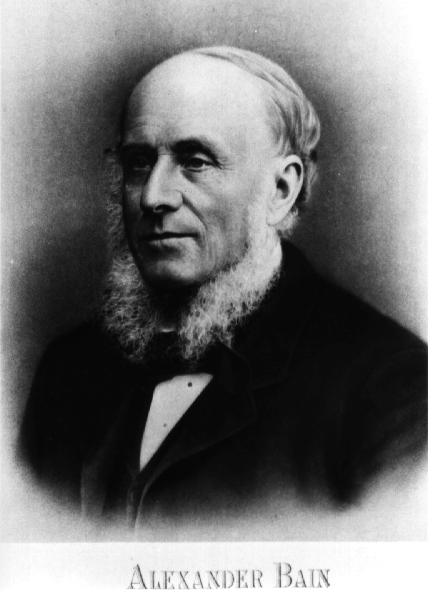
Alexander Bain
Alexander Bain's Improved 1850 Model
   A Scottish inventor, Alexander Bain, began his career as an apprentice to a clockmaker. He actually invented the first electric clock, which had a pendulum powered by an electromagnet. This invention would come in handy when he started to think about transmitting messages. The fax machine he invented actually used clockwork principles and parts to operate. He patented the first primitive fax machine in 1843, some 30 years before the telephone. Called the "recording telegraph," Mr. Bain's invention used a stylus attached to a pendulum, which passed over metal type to sense light or dark spots on the plated "document" being sent. A pendulum on the receiving device made a stain on chemically treated paper when electric charges were sent on a telegraph line.  The chemical he employed to saturate the paper was a solution of ammonia and prussiate of potash, which left a blue stain on being decomposed by the current from an iron contact or stylus. The signals were the short and long, 'dot' and 'dashes' of the Morse code. The speed of marking was so great that hand signaling could not keep up with it.
     The chemical telegraph was tried between Paris and Lille before a committee of the Institute and the Legislative Assembly. The speed of signaling attained was 282 words in fifty-two seconds, a marvelous advance on the Morse electro-magnetic instrument, which only gave about forty words a minute. 


Monday, November 22, 2010

Turkeys Leave Country, Spending Holiday Overseas!

Turkey May Be Rarity on Thanksgiving Table, 
But You Can Be Thankful It's in Good Hands

Courier Express September 18, 1943

  There are 68 more days until Thanksgiving, and you can do your worrying about that turkey during the last 41. The first 27 days, or until October 15th, you can spend being thankful that the turkey you might not get will go to our boys overseas. This about sizes up the situation. Some time ago the government slapped a two-way freeze order on the national turkey crop.  It froze the sale of the birds until it can buy up 15,000,000 to 20,000,000 pounds needed by the armed forces, and it is now freezing the birds for shipment overseas.

Turkeys remaining after Uncle Sam has his share, will be allocated for civilian use.
   While October 1st is the date set tentatively for relaxing the freeze order, Buffalo poultry dealers heard at their national convention in Chicago this week that, to date, the government has bought only 5,000,000 pounds. They figure the quota will not be completed before mid October at the latest. What are the chances of getting a Thanksgiving turkey? One leading Buffalo poultry dealer said yesterday that "we can't even think of that possibility yet." A "sprinkling" of turkeys may come through after October 15th, and by the time Thanksgiving rolls around on November 25, there may be enough to go around, he said. But he made it clear that everything is up in the air now.  One of the poultry dealers who attended the Chicago convention said it was reported there while the nations poultry crop this year, is the largest on record, turkeys are down 10 percent from last year.
  With the government's 1943 holiday turkey order much larger than last year, and on a smaller crop on which to draw, the prospect of enough turkeys to supply the civilian demand is extremely slender, this dealer said.  
  On the other hand, he pointed out, with the biggest crop of poultry of all time, there will be a choice of substitutes for the Thanksgiving piece de resistance. While poultry is rather scarce right now, it is expected to start coming to market in quantity when the poultrymen bring in their young flocks from the range and begin liquidating old stock to make room. "By early November, and until over the holidays, the poultry supply should increase by leaps and bounds," this dealer added.  The small local turkey grower heads a priority list of consumers reasonably sure of having turkey to eat on Thanksgiving.
  Next in order of reasonable sureness are his consumers of long standing, many of whom have had their Thanksgiving and Christmas orders in since last year.
   Although the turkey grower with flocks of up to a few hundred birds is subject to the freeze order, the government has not called on him so far. Buying in such huge quantity, it has to depend chiefly on the big western turkey ranches. Still another factor in the local small turkey growers favor, is that his birds are not due to be ready until a few days before the holiday. Uncle Sam wants birds that are ready now, so they may be frozen and shipped in time to reach their far-flung destinations before the holidays.
Land Girls on an Essex turkey farm round up the 
turkeys for the last time. December 23, 1944
Courier Express Nov. 14, 1943
   Home used to be the only place to get a  real old fashioned Thanksgiving dinner with turkey and all the trimmings. This year it may be the only place you can't. Speaking of old fashioned Thanksgiving dinners...It's what the soldiers at Fort Niagara will down at their noonday meal on November 25, and is typical of the fare to be served that day at all the service posts in this area.  "We expect to have two shifts of cooks working all night before Thanksgiving"...said Capt. Harry Betts, food service officer at Fort Niagara. "Our Thanksgiving menu calls for 2,300 pounds of turkey." 
The only men at Ft. Niagara not sure of having turkey for Thanksgiving are the 10 percent who will be home on furlough.    
   Turkey to the tune of 40,000 pounds is being readied for the Naval Training Station at Sampson, largest of the service camps in the Buffalo area. Smaller military posts in the area all are building their holiday menus around turkey. These include Camp Curtiss Air in Cheektowaga, Camp Bell in Niagara Falls, the aviation students at the University of Buffalo and Canisius College, the M.P.'s of the Second Service Command, and the anti-aircraft crews.  
Woman Land Army Trainees
 Carrying Turkeys
  There is just one drawback to the whole Thanksgiving show as far as the men are concerned. With few exceptions, Thanksgiving will not be a holiday. They will have the usual hour to eat the holiday meal and enough work afterwards to work it off. The Military Police guarding Italian war prisoners at work in Western NY canning factories will have to take pot-luck unless they work out of an army post such as the one at Attica. Guards stationed at such posts as the Heinz plant at Medina, are fed at the plant Cafeteria, and take whatever is offered.
  None For Prisoners
   Asked if the Italian war prisoners--some 800 of them are working in the Buffalo area--would have turkey for Thanksgiving, Col. McDowell said: "With thousands of Americans having to go without turkeys this year so our men in the armed forces could have them, my guess would be, no."

Courier Express November 17, 1943
Roast Chicken Joins Turkey in the 
"IF" Class
Dealers Fear Supply May Not Fill Demand.  If your all through worrying about the turkey that you can't have for Thanksgiving, and you'll settle for a nice, fat roasting chicken, you can now start worrying about getting that nice, fat roasting chicken.  While Buffalo poultry dealers expect a fair supply of chickens for next weeks holiday, they also anticipate a demand all out of proportion to other years, as a result of the acute turkey shortage.  They fear that no matter how many birds they get, the supply will be too small to go around.  As to the OPA cracking down on certain dealers who, it charges, "have deliberately corralled the turkey market in this territory," these dealers enquired yesterday: "What turkey market?" 
              
 Defends Buffalo Dealers  "You've got to have the merchandise before you can corner the market on anything," said one.  "If there are any turkeys in Buffalo, outside of the exception to prove the rule, I'd like to know it." Harley T. Jones, a poultry buyer for Hickman, Coward & Wattles, Niagara Frontier Food Terminal, returned yesterday from a buying trip to the midwest, where, he found few turkeys available at ceiling prices. "But I bought all the chickens in sight, and they weren't too easy to find either.  We are laying in about three times as many chickens as we ordinarily do, as we expect the demand to be tremendous, with families going in for two or three chickens in place of the one turkey they would have bought."

   A spokesman for the Will Poultry Co., 1223 William Street, attributed the turkey and general poultry shortage to the fact that "the government froze turkey sales too long." They were frozen during August, September and October, he said during which time the packers usually dress and freeze their stock for the holiday market. As another result of the government freeze order, he said, birds not taken for the armed forces were permitted to get too big for the ordinary market. He reported one turkey farmer in Fredonia, who raised between 6,000 and 8,000 birds, has many weighing as high as 28 to 30 pounds.
  The Will Poultry Co. representative said that while his company will have more chickens than usual for the holidays, roasting birds will be fairly scarce. Fairmont Creamery, which expects to have 15-20% of it's normal allotment of turkeys, said yesterday, it's supply of chickens "will not be anywhere near what we'd like." We found, General Manager Ingraham said, "that chickens as well as turkeys are pretty scarce in the Midwest."
    Editor: So Everybody be thankful for what you have this Thanksgiving, whatever fare is on your table.  If you have little, be thankful for what it is you do have, there are others who have even less. If you have much, be thankful for the abundance bestowed on you, and give what you can to those who have less and help restore a balance and faith in Mankind. And always give thanks to those in our armed forces who are putting their lives on the line everyday, fighting, so we may all celebrate in peace.  
   

Wednesday, November 17, 2010

Leaving Home...

Buffalo NY 1942 - some excerpts from an undetermined local paper
When the Last of the Seneca Indians Left 
Buffalo 100 years Ago - 1842
  Buffalo was actually founded by the Seneca Indians in 1780.  They welcomed the white settlers who later forced them to sell their land rights in 1842 and move out of the city they founded, onto reservations they occupy today....


  One of the most difficult problems the founders of Buffalo had to solve, was getting the Seneca Indians to give up their land along Buffalo Creek. The first permanent settlement on the site of modern Buffalo was actually made by the Seneca Indians in 1780. On Buffalo Creek some three or four miles from it's mouth, the first Seneca villages were established during the Revolutionary War, after Sullivan's raid destroyed their old homes in the Genesee Valley. The proud and formidable nation fled, panic stricken, from their 'pleasant valley', abandoned their villages and sought British protection under the guns of Fort Niagara.
   Col. Guy Johnson fed the Indians from the British commissary at Fort Niagara during the winter of 1779-80.  British officers from Fort Niagara encouraged some 1,500 of them to settle on Buffalo Creek to plant these places, to lessen the burden and expenses at the Fort.  In this neighborhood was built a council house, at which councils and treaties of national importance were held. Associated with it are the names Young King, Farmers Brother, Red Jacket and other Native American celebrities. In this vicinity is the well known site of the Seneca Mission Church built in 1826 and abandoned in 1843. Indian Church Road runs through the old church yard and near the site of the building.
   The date of the beginning of settlement "was probably May or early June" of 1780. There had been no permanent abiding place there until that time. Soon after their arrival the squaws began to clear the land and prepare it for corn, while the men built some log-huts then went hunting. The Senecas at Buffalo Creek were under the leadership of Siangarochti, or Sayengareghta, and influential Chief, sometimes called Old King. His family alone raised seventy-five bushels of corn during that first summer at Buffalo Creek.

Map Showing Location of Buffalo 
Creek Indian Reservation
  After the Revolution, the Seneca title to the land along Buffalo Creek was recognized by the government, and the Seneca Village occupied some of the choicest land in Buffalo. As the white settlers continued to come into Buffalo, the Indians became a greater problem. When Buffalo began to expand with the opening of the Erie Canal in 1825, the Seneca Indians became a first class "headache" for the Village Fathers. Those remnants of the once mighty Iroquois had not taken too well to the white man's way of living...but the Senecas legally owned the land, and they would not sell or move.
  In 1838, a combination known as the Ogden Company began negotiations with the Indians in Western New York, and in January of that year, a council of chiefs was held in Buffalo.  How the Ogden Company got the various chiefs to sign away their land rights is a dark and shameful chapter in Buffalo History. Scandalous methods of bribery and intoxication where used, and many of the signers were not  recognized chiefs of the Senecas. The Ogden Company offered fabulous sums of money (which were never paid) and 1,820,000 acres of land in Kansas. The people of Buffalo were incensed over the way their Red neighbors were treated, and because of their opposition, the Ogden Company did not attempt to force it's questionable claims to the Indian lands.
The Great Seneca Orator - Red Jacket
1751 - 1830
  A committee of arbiters from Buffalo finally brought the dealings with the Senecas to a successful conclusion, and in May, 1842, the Senecas agreed to give up their land on Buffalo Creek and move to reservations set up for them at Cattaraugus and Allegany. The Buffalo arbiters saw to it that the Indians were paid a fair price for the land they gave up at Buffalo Creek, but the Senecas at Tonawanda flatly refused to deal with the Ogden Company or the arbiters. The government finally bought the entire claim of the Ogden Company and dealt with the Tonawanda Indians seperately.  
   True to their agreement with the people of Buffalo, the Senecas began to move out of Buffalo in 1842, and soon there were few of them left along the Creek. The land they once owned on Buffalo Creek has since become the heart of the industrial and shipping enterprises in Buffalo. 


Monday, November 15, 2010

George Adell Buffalo's Early Aviator - 1911


Buffalo News May 28 1929
Blazed Trail Over Niagara in 1911
----------------------------------------
Man Who Flew Spidery Plane over Niagara Still Hale at 72
In a Curtiss type biplane, which he built himself, George Adell, 72 of 142 Masten Street, made 
frequent flights over the Niagara River in 1911. Seated at the controls of the plane is Charles Mills, 
his partner in exhibition ventures.
   A Spidery looking contraption which made noisy and sometimes erratic progress through the air around Buffalo in the year 1911 evoked no little comment on the foolhardiness of it's sole passenger. Nevertheless the man that built that primitive airplane and flew it on the first flight across the Niagara River 18 years ago is still hale and hearty and as deeply interested in aviation as he was then.  He is George Adell, 72 of 142 Masten Street, an employee of the Lamson Co. of Boston for more than 45 years.  Back in 1872 when he was a boy in his teens in Auburn, he assisted an itinerant fakir to construct what would be known now as a helicopter.  His lifelong interest in aviation dated from that day.  
                                                                                                     It  Failed  to  Fly
Photo from my own collection of what may be Mr. Adell's plane
flying near Niagara River around Buffalo
   A portable steam engine was installed in the center of the platform and was surmounted by a huge propeller, which incidentally would not lift the clumsy ship, but proved a great drawing card for curious persons who were willing to pay money to see even an airplane that wouldn't fly.  Five or six years later entered into a partnership with a Professor Baldwin and the daring couple spent several months making balloon flights at county fairs.  The venture was a huge success until one summer day the valve in the envelope refused to function and they finished the flight from Auburn in a farmers apple tree ten miles away. That finished Mr. Adell's brief career as a balloonist.
Mr. George Adell
Built  First  Plane
   Mr. Adells interest in aviation, which waned somewhat after that disastrous experience, revived again after he moved to Buffalo in 1898, and when Orville Wright and Glenn Curtiss were experimenting, he decided to construct his own plane.  He secured plans for nine different types of ships for the percival Marshall Co. of London, England, and choose the Curtiss ship as the safest and easiest of operation.  At a cost of $2000 he built the machine in a shop in the Sidway Building in 194 Main Street. It was two years in the making.  After several brief but successful flights in it from the Country club grounds at Niagara Falls, he made the longest trip up the river to Fort Erie.


Photo from my own collection what may be Mr. Adell's plane
landing somewhere in or around Buffalo

                                                    Flew  Over  The  Cataract
 The decision to make exhibition flights when he took into partnership with him Charles Mills, an electrician aviator, who flew the machine over the Cataract for the first time.  They demonstrated in all parts of the state with only one accident.  In Binghampton one day Mills crashed from a height of 100 feet, breaking his collar bone and smashing the airplane. The dismantled ship is packed carefully in boxes in a warehouse in Tonawanda at the present time, but Mr. Adell has never lost his deep interest in aeronautics and is at present constructing planes of new and radical design.

Editors Note: Still looking for more information on this gentleman. If any one can provide more insight on Mr. Adell, please contact me.  The photo's are just an assumption on my part that they are of him.  They came from a collection I acquired from someone in the Buffalo area.  Any aeronautical  experts that wish to chime in on this feel free to do so. Thanks,  Jerry Malloy

Saturday, November 6, 2010

The "House" of Invention

     First Car in England Built by a House From Buffalo!

Buffalo Times, February 22 1931

Harry A. House Jr.
   If that sounds a little strange, it's not.  Not if the house was Harry A. House Jr. of 42 Fordham Drive, Buffalo. He designed, built and drove the first automobile in England. His father is conceded by many to have constructed America's initial automobile, which alarmed the citizens of Bridgeport Conn., in 1866.  Retired now after 15 years as chief engineer of the former Wire Wheel Corporation of America here, House works daily in a fully equipped machine shop in the basement of his home, perfecting ideas to swell his total of half a hundred patented inventions.
Got First License in 1897
   The first license that England ever issued, which bears his name, hangs in the club rooms of the Royal Automobile Club of Great Britain, to which both House and the Prince of Wales belong. The license was issued in 1897 at Somerset House where deeds and records are kept in London. It was larger than a present day birth certificate and bore the royal coat of arms. House and his father, Henry A. House Sr., went to England in 1889 to join Sir Hiram Maxim (machine gun inventor) in working out a flying machine. Wilbur Wright came to England at the time to view the invention.  Several trial flights ended disastrously and backers of the project eventually withdrew their support. The flying machine was abandoned by Sir Hiram and his two American helpers. 
Maxim's Steam Powered Aircraft -1890's 
Made Steam Driven Vehicle
  The elder House returned to the United States while his son remained in England and began experimentations on a self-propelled commercial vehicle. He evolved a steam driven machine which weighed a ton and a half and which was capable of achieving a speed of 30 miles per hour. The steam was generated by kerosene oil and a funnel led out through the top to carry out the heat.  A license had to be taken out before the steam auto could be operated generally on the roads.  There wasn't any form to cover such a situation, so one was hastily and elaborately devised.  It cost House two pounds (about ten dollars) to take out his first license.   
  The government became interested in the vehicle and as a experiment used it for Royal Mail Service. For Six weeks, Houses' automobile carried the mail from London to Riegate, a distance of 30 miles.  Sharply at 10 the steam car would chug off on it's mission while crowds gathered to see the horseless contraption make it's way over the bumpy roads.
Double Decker Comes Next
  Later house designed a double-decker car with a majestic funnel rearing from the top. This machine was taken to France. The inventor holds a gold medal and two silver for his earlier designs in automotive vehicles. The younger came to Buffalo and took up duties with the Wheel Corporation.  He became chief engineer and invented numerous wire wheel designs and processes for making them. He perfected wheel balances, a foot-lifting jack and auto accessories. During the course of his 19 years in England he was made Vice Consul at Southampton. Today he is 65 and still drives an automobile.
Henry A. House Sr.'s Automobile,
Bridgeport - 1866
  The senior House died in his Bridgeport home, at the age of 90, in December of 1930. He had invented mechanical devises for the airplane, auto and numerous other types of machinery. Altogether he was credited with over 300 inventions. The story is told in Bridgeport that a balky horse caused House Sr. to invent the first automobile. "Better no horse at all than one that balks," he said, according to legend, then he set about designing a vehicle to eliminate the cantankerous horse. 

Editors Note:  Hiram Maxim did actually achieve flight by accident although not "controlled." Just a few feet off the ground then crashed. He used lightweight steam engines.  The area he was testing at did not allow for full takeoffs. The steam engines, although powerful enough to lift the huge aircraft could not hold enough water for anything other than a short flight even if it could take off. Search: Hiram Maxim airplane, for details on his flight experiments in the 1890's. I am still researching the Henry A. House Sr. automobile in Bridgeport Conn. If anyone has information on any of the inventions mentioned in this story, please contact me by email.  
Thanks

Monday, November 1, 2010

Brodie's "Tin Hat"

He Made the World's "Most Famous Hat"
Local Genius Invented Many War Devices,
But None So Thankfully Received by 
Doughboys as the Famous "Tin Kelly."

Buffalo Times April 4, 1926
Canadian infantry of the 27th Battalion with
a Lewis machine gun and steel helmets
   It seems that there can't be much romance in hat making, ordinarily, and not if it's an ordinary kind of hat. John Leopold Brodie, No. 806 West Ferry Street, found romance in his creation however, romance and adventure in quantities to satisfy almost anyone. It was Mr. Brodie who invented the Tin Hat of war-time fame. To Mr. Brodie thousands, perhaps hundreds of thousands allied soldiers owe their lives. Many of the doughboys with a streak of curiosity to peek over the top of a besieged trench, were saved from an army blanket and last post honors by the tin hat.
   Mr. Brodies' hat was first chosen by the British Government, and later by the United States Government, as the most efficient life saving hat of more than 40 models offered them. Tests proved that the hat was so constructed that it was practically bullet proof, and the cushioning cage inside, resisted the shock. Under service conditions it was found that the hat cut down on head wounds by 60 percent.    
    Mr. Brodie has many inventions to his credit. One was a chain steel visor attached under the tin hats and so arranged as to pull it down in front of the eyed for protection from shrapnel. Another war time invention was a message carrying rocket which could be set for a certain distance as the case might be, and save sending a man a man out under fire to a sure death. Also a face protector for tank operators, other were service smoke helmets and gas alarms, most of which saw a great deal of  active service in France.  He is also said to have developed the "stop and go" traffic light.
   He was born July 10th in Riga Russia and had an adventurous career. As a young man, Mr. Brodie  went to South Africa and was subsequently interested, as an owner, in the development of diamond and gold mines there, and eventually made a fortune in gold and diamonds at the Kimberly and Johannesburg treasure mines. For several of his years there he was closely associated with Cecil Rhodes. He returned to England and invented a chemical process for the manufacture of salt and engaged in that business until 1914. He is said to have refused a Knighthood in England and to have come to Buffalo just after the armistice to live, solely because his wife (Eleanora Thompson), wished to live in the city of her birth. Mr. Brodie for a number of years has been one of Buffalo's most distinguished citizens, richest of all local war millionaires and possibly the wealthiest man in the city. He received his U.S. citizenship in 1924.
   Although reticent about discussing the invention of the most famous hat in the world, he says he conceived of such a hat after statistics showed that about 750 out of a thousand wounded soldiers were suffering from head wounds.  One of the tests that Mr. Brodie put his hat through in order for the government to accept it from among 40 or 50 others,  was to put it on his head and allow it to be struck with a heavy steel bar.  He had so much confidence in  his invention that he was even willing to have the government inspectors shoot at the hat with a 45 caliber revolver while he was wearing it.  This was not considered necessary, however. 
   Mr. Brodie is asking a royalty for the use of his invention from the United States Government. So far he has received nothing but the heartfelt thanks from the thousands of American soldiers.  They didn't know who to thank for the hat when they were in the trenches, and they probably never will know, but they say thanks just the same.
   During the first year of World War I, none of the combatants offered steel helmets to their troops. The soldiers of most nations went into battle wearing simple cloth caps that offered virtually no protection from modern weapons. German troops wore the traditional leather Pickelhaube, also of little protective value.
    The Brodie helmet (also called the shrapnel helmet or Tommy helmet, and in the United States known as a doughboy helmet) was a steel helmet designed and patented in 1915 by John L. Brodie. The War Office Invention Department was asked to evaluate the French Adrian design but they decided that it was not strong enough and was too complex to allow quick mass production. The design submitted by John L. Brodie offered advantages over the French design as it could be pressed from a single thick sheet of steel, giving it added strength. The British Army first utilised the helmet in September of 1915 but it was not until the spring of 1916 that the helmet began to be issued to British troops in large numbers. It was first used in battle in April 1916 at St Eloi. Troops from other countries in the British Empire also used the Brodie helmet as did the United States when they entered the war in 1917. The United States Government initially purchased some 400,000 helmets from Britain.

Search Amazon.com for BRODIE HELMET

Editors Note:  For the record, newspapers in general do not always get every fact correct regarding subject matter (not a big surprise). There were  some conflicting minor biographical information in articles written at different times I found about John Brodie. If ever any reader has additional information regarding John Brodie, that may differ from what I have, feel free to bring it up to me, and I will take it into consideration. Thanks